
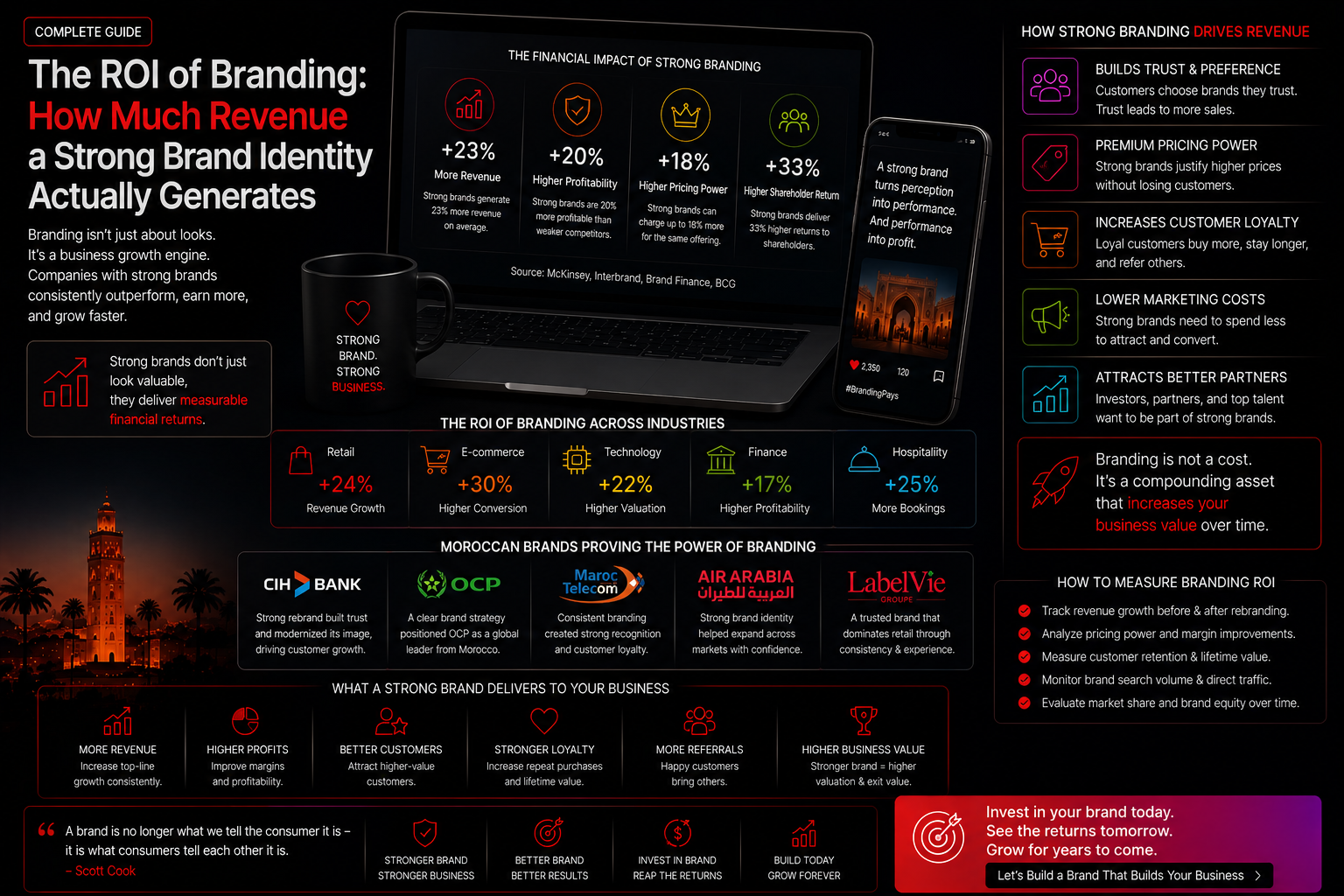
Branding has long been dismissed by skeptical business owners as a soft, hard-to-measure expense. The data tells a very different story. Here's exactly how much revenue a strong brand identity generates — with the numbers to prove it.
"How do I know branding actually pays off?" is one of the most common questions business owners ask before investing in identity work. It's a fair question — and one with a clear, data-backed answer that goes well beyond subjective aesthetic preference.
Branding isn't decoration. It's a measurable business asset that directly influences pricing power, customer acquisition cost, conversion rates, and long-term customer loyalty. Here's how each of these connects to real revenue.
How Branding Drives Measurable Revenue
💎 Pricing Power
Strong brands command premium pricing without resistance. Consumers consistently pay more for products and services from brands they perceive as higher quality and more trustworthy — even when the underlying product is functionally similar to lower-priced alternatives. This pricing premium flows directly to margin.
📉 Lower Customer Acquisition Cost
A recognizable, trusted brand reduces the skepticism a new prospect must overcome before converting. This means fewer touchpoints needed to close a sale, higher conversion rates from the same ad spend, and ultimately a significantly lower cost to acquire each new customer.
🔁 Higher Customer Retention
Strong brand identity creates emotional loyalty that transcends pure transactional relationships. Customers who feel a genuine connection to a brand are dramatically more likely to remain loyal even when competitors offer lower prices.
📣 Increased Referral Rate
People refer brands they're proud to be associated with. A strong, distinctive brand identity gives customers something clear and memorable to describe when recommending you — directly increasing word-of-mouth growth, the lowest-cost acquisition channel available.
💼 Easier Talent Acquisition
Strong employer brands attract better talent at lower recruitment costs — an often overlooked but financially significant branding benefit, particularly for growing businesses competing for skilled employees.
Calculating Your Potential Branding ROI
While exact figures vary by industry, a useful framework for estimating branding ROI considers three factors: the price premium a stronger brand could justify (even a 5-10% price increase compounds significantly across annual revenue), the reduction in marketing spend needed to achieve the same conversion volume due to increased trust, and the lifetime value increase from improved customer retention rates.
For a business generating 2 million MAD annually, even modest improvements across these three factors — a 5% price increase, a 15% reduction in acquisition cost, and a 10% improvement in retention — can translate into hundreds of thousands of MAD in additional annual profit, often for a branding investment representing a small fraction of that return.
Why Many Businesses Underinvest in Branding
The ROI of branding is harder to track in real-time than the ROI of a single ad campaign, which leads many business owners to underinvest relative to its actual impact. Branding works cumulatively and often indirectly — influencing every other marketing effort's effectiveness rather than producing an isolated, immediately attributable result. This makes it easy to deprioritize despite its outsized long-term impact.
💡 Zelon's Branding Philosophy: We treat branding as a profit center, not a cost center. Every brand identity project we undertake is built around the specific business outcomes — pricing power, lower acquisition costs, increased loyalty — that justify the investment.