
Brand identity is more than a logo and a color palette — it's the complete system of perceptions, feelings, and associations your business creates in the minds of your audience. Here's exactly how to build one from the ground up.
Many business owners confuse brand identity with visual design alone — believing that hiring a designer to create a logo and choosing a few brand colors completes the process. In reality, a strong brand identity is a comprehensive system encompassing strategy, visuals, voice, and consistent experience across every touchpoint.
This step-by-step guide walks through the complete process of building a brand identity that actually creates differentiation and lasting recognition in a crowded market.
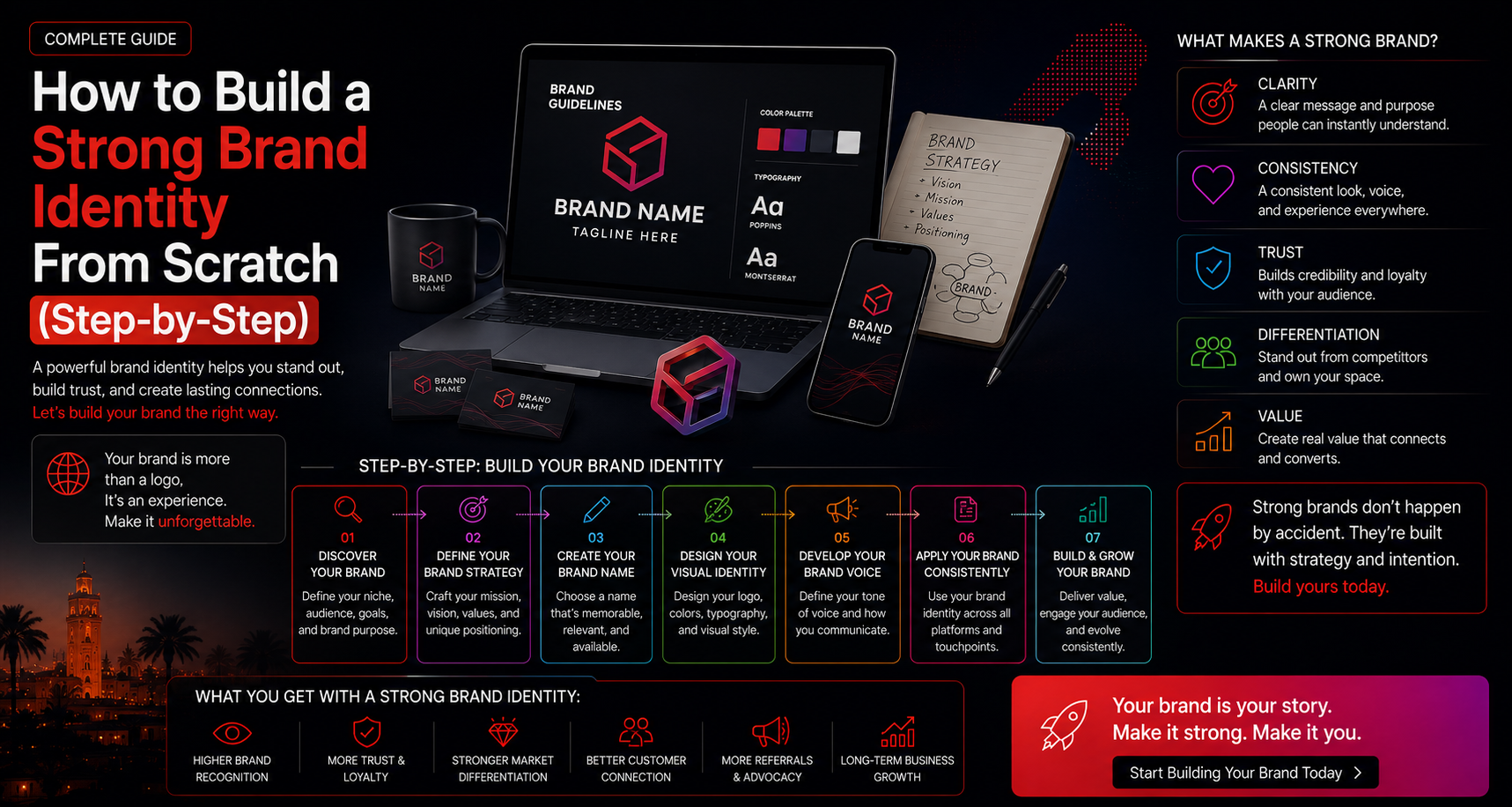
Step 1: Define Your Brand Strategy First
Before any visual work begins, the foundational questions must be answered with clarity: Who exactly is your target audience? What specific problem do you solve for them? What makes your approach genuinely different from competitors? What values does your brand stand for, beyond profit? Skipping this step and jumping straight to visuals is the single most common mistake in brand identity development — it produces beautiful designs built on no strategic foundation.
Step 2: Develop Your Brand Positioning
Brand positioning is the specific space you occupy in your customer's mind relative to alternatives. A clear positioning statement typically follows this structure: "For [target audience], [brand name] is the [category] that [unique benefit] because [reason to believe]." This single sentence becomes the filter through which every future brand decision is evaluated.
Step 3: Build Your Visual Identity System
🎯 Logo Design
Your logo should work across every context — from a website header to a tiny social media avatar. Simplicity and versatility matter more than complexity or trendiness.
🎨 Color Palette
Choose 2-4 primary colors that reflect your brand's personality and differentiate you from direct competitors. Colors carry psychological associations — research what your chosen palette communicates before finalizing it.
✍️ Typography System
Select 2 complementary typefaces — one for headlines, one for body text — that reinforce your brand personality, whether that's modern and minimal or warm and traditional.
📷 Photography & Imagery Style
Define a consistent visual style for all brand photography and imagery — lighting, color treatment, composition style — so every piece of content feels unmistakably yours.
Step 4: Define Your Brand Voice
How does your brand sound when it communicates? Formal or casual? Playful or authoritative? Direct or storytelling-driven? Documenting your brand voice with specific examples — words you use, words you avoid, sample sentences in your brand's tone — ensures consistency across every piece of content, regardless of who's writing it.
Step 5: Create Brand Guidelines
All of the elements above should be documented in a clear brand guidelines document — covering logo usage rules, color codes, typography specifications, voice examples, and dos and don'ts. This document becomes the reference point for every designer, marketer, or partner who creates content for your brand going forward.
Step 6: Apply It Consistently Everywhere
A brand identity only becomes powerful through repetition and consistency. Every touchpoint — your website, social media, packaging, email signatures, presentations, even how your team answers the phone — should reinforce the same identity. Inconsistency is the single biggest destroyer of brand equity, regardless of how well-designed any individual element might be.