
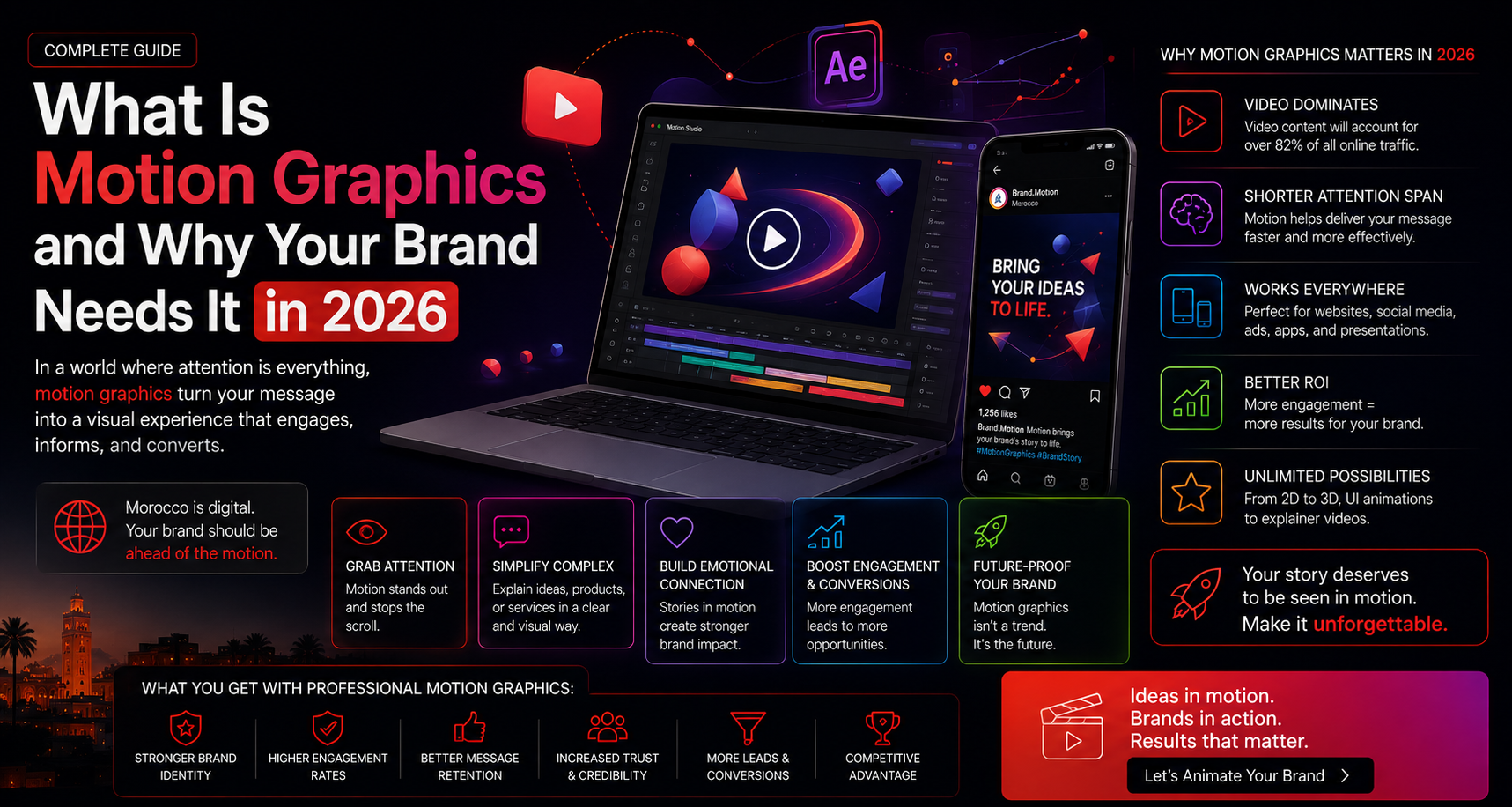
It's one of the most searched questions in design and marketing right now — and for good reason. Understanding what motion graphics actually is, and why it's become essential for modern brands, can change how your business communicates entirely.
Motion graphics is the art of bringing graphic design elements — text, logos, icons, shapes, illustrations — to life through animation. Unlike traditional character animation (think cartoons or animated films), motion graphics typically focuses on visual communication: explaining ideas, highlighting data, building brand identity, and guiding attention through movement.
If you've ever watched an animated logo reveal, a kinetic typography video, an animated infographic, or a sleek product explainer with shapes and text moving smoothly across the screen — you've experienced motion graphics. It sits at the intersection of graphic design, animation, and storytelling.
Motion Graphics vs. Animation: What's the Difference?
While the terms are often used interchangeably, there's a meaningful distinction. Animation typically refers to bringing characters or narrative scenes to life — think Pixar films or cartoon series. Motion graphics, by contrast, generally focuses on abstract or graphic elements: typography, icons, data visualizations, and brand assets in motion. Motion graphics is almost always shorter, more design-driven, and built specifically for marketing, branding, or explanatory purposes rather than entertainment narratives.
Common Types of Motion Graphics
🎯 Logo Animations
A brand's logo brought to life through movement — used in video intros, app loading screens, and social media to create memorable, recognizable brand moments.
📊 Animated Infographics
Data and statistics transformed into engaging visual sequences that communicate complex information faster and more memorably than static charts or text.
✍️ Kinetic Typography
Text that moves, scales, and transforms in sync with audio or rhythm — frequently used in social media captions, quote videos, and explainer content.
🎬 Explainer Videos
Animated sequences that walk viewers through how a product or service works, commonly used by tech companies and service-based businesses to simplify complex offerings.
🔄 UI/UX Motion
The subtle animations within apps and websites — button transitions, loading states, micro-interactions — that make digital products feel polished and responsive.
Common Types of Motion Graphics
Why Your Brand Needs Motion Graphics in 2026
As digital attention becomes increasingly fragmented, motion graphics offers a way to communicate brand personality, explain complex value propositions, and capture attention — all within seconds. It bridges the gap between static design (which can feel flat in a video-dominated digital landscape) and full video production (which can be costly and time-intensive for every piece of content).
For businesses without the budget for full video production on every piece of content, motion graphics offers a cost-effective middle ground: visually engaging, brand-consistent, and significantly faster to produce at scale than live-action video.
💡 Zelon's View: Motion graphics isn't a luxury add-on anymore — it's becoming the baseline expectation for any brand communicating on digital platforms. Brands that haven't yet invested in it are increasingly noticeable for the wrong reasons.