
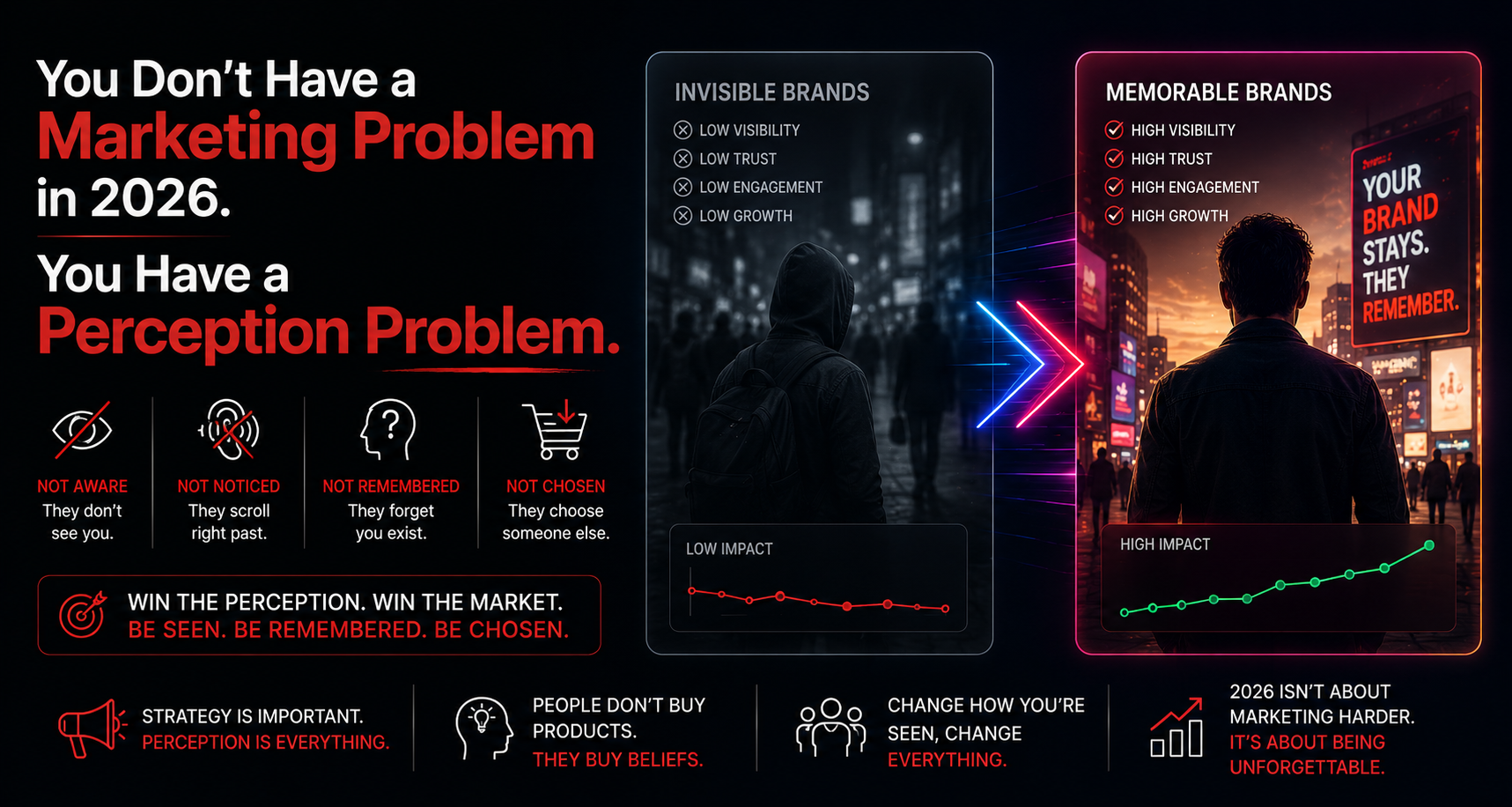
Every business that struggles to grow has been told the same thing: market more. Spend more. Post more. But more of the wrong thing is just more wrong. The real issue — almost always — is not how much you're communicating. It's what people believe about you.
Here's a question that most business owners have never been asked directly: What do people believe about your brand when they're not thinking about it? Not what do they know. Not what they've been told. What do they believe — at the gut level, below conscious thought — when your name comes up?
That belief — or its absence — is your real marketing challenge. Not your posting frequency. Not your ad budget. Not your follower count. What people believe about you determines whether they buy from you, whether they recommend you, whether they pay your full price without negotiating, and whether they stay loyal when a competitor offers something cheaper.
Everything else is downstream from perception. And perception is exactly what marketing was always supposed to manage — but rarely does.
Why More Marketing Doesn't Fix a Perception Problem
When growth stalls, the instinct is to amplify. Run more ads. Post more content. Attend more events. But amplification only works when the signal is clear. When the underlying perception is weak, confused, or nonexistent, amplification just broadcasts the problem more widely. You spend more. More people see your brand. More people feel — nothing. Because there was nothing clear for them to feel.
The businesses that break through are almost never the ones that outspend their category. They're the ones that out-position it — that stand for something so clear, so specific, so genuinely resonant that when people encounter their brand, they immediately understand exactly why this brand exists and why they should care.
Diagnosing Your Perception Problem
🔍 The Blank Description Test
Ask five people — clients, colleagues, acquaintances — to describe your brand in one sentence without prompting. If you get five different answers, or if the answers are vague ("they're good at what they do"), you have a perception problem. A strong brand produces consistent, specific responses.
💰 The Price Resistance Test
When you raise prices, do clients accept it without question — or do they push back and shop around? Price resistance is almost always a perception problem. When people believe a brand is exceptional, they pay exceptional prices without hesitation.
📣 The Referral Test
How easily can your clients describe you to a friend? If they struggle to articulate what makes you different, they won't refer you — not because they don't value you, but because they can't easily explain you. A brand with a clear perception makes its clients into natural advocates.
🏆 The Category Default Test
When someone in your city needs what you offer and asks a friend for a recommendation — is your name the one that comes up first? Category default status is the ultimate measure of brand perception. It's what every brand is ultimately building toward.
🧠 The Zelon Belief: Marketing doesn't create perception. It reveals it — or fails to. Great brands don't manufacture perceptions from nothing; they find the truth at their core and communicate it with such clarity and consistency that the right audience immediately recognizes it as theirs. That's what we help brands do.
Fixing the Perception Problem: Where to Start
The starting point is always clarity — not creativity. Before any campaign, any content, any design decision, the fundamental questions must be answered with absolute precision: Who exactly is this brand for? What do we want those people to believe about us? And why should they believe it? What's the proof?
Once those questions have true, specific, honest answers, the creative work — the identity, the campaigns, the content — becomes dramatically easier and dramatically more effective. Because you're no longer trying to create something out of nothing. You're trying to communicate something real. And real, told beautifully, is the most powerful force in marketing.
In 2026, the brands that win are not the loudest. They are the clearest. And clarity is a choice that any brand — regardless of budget, size, or sector — can make right now.