
Most businesses invest in video production and then leave the results entirely to chance — posting and hoping the algorithm does its job. Video SEO is the discipline that removes chance from the equation and ensures the content you create actually gets found by the people who need it.
Video is the fastest-growing content category on the internet. YouTube is the world's second-largest search engine. Google now features video results prominently across a wider range of searches than ever before. Yet the vast majority of businesses that invest in video production give almost no thought to how those videos will be discovered organically — and as a result, they leave enormous amounts of value on the table.
Video SEO is the practice of optimizing your video content so that it ranks in search results — both on YouTube and in Google's main search results — for the terms your ideal clients are searching for. Done correctly, it turns every video you produce into a long-term client acquisition asset rather than a one-time social media post.
How Google and YouTube Rank Videos
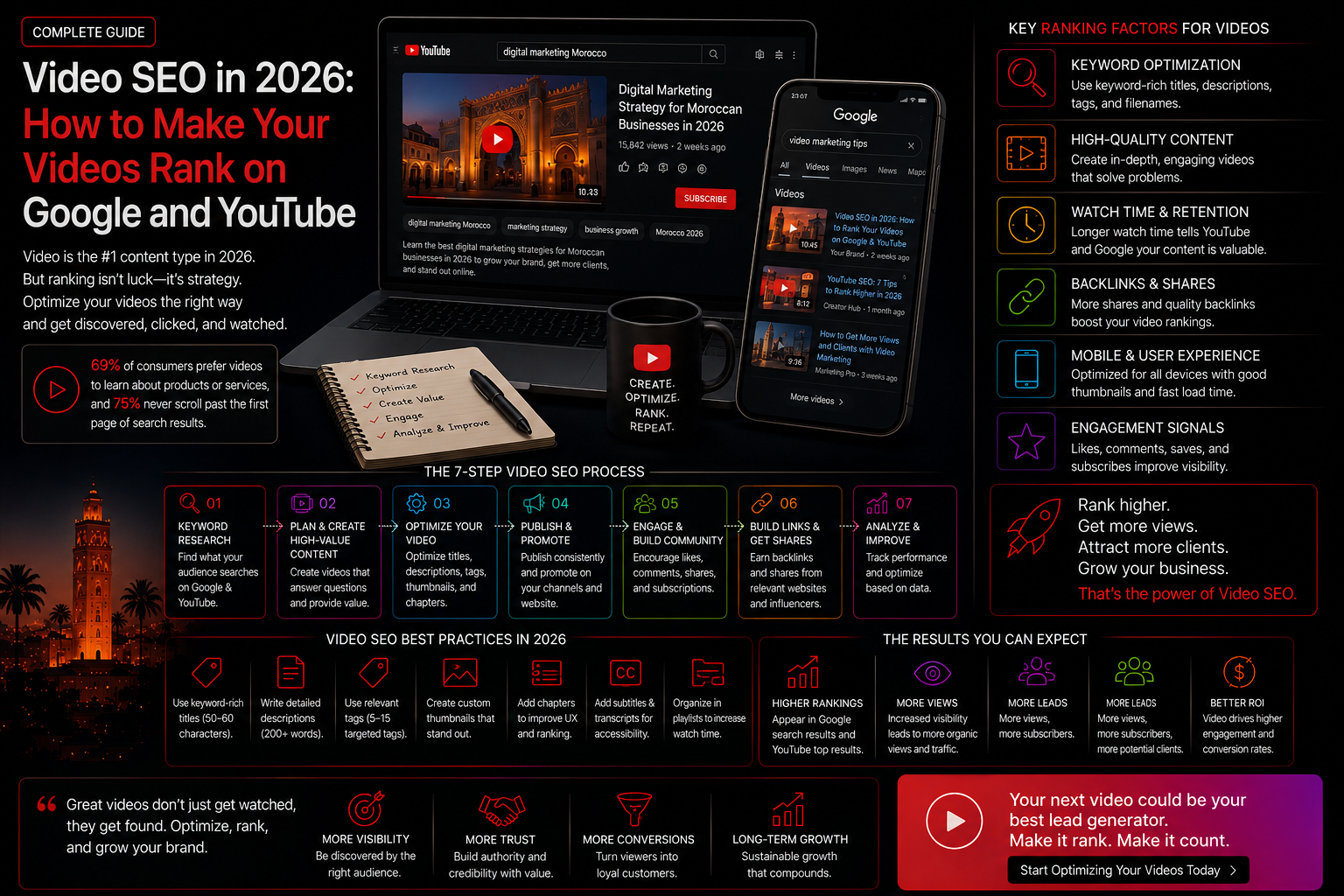
Both Google and YouTube use signals to determine which videos best answer a searcher's query. Understanding these signals is the foundation of video SEO. The key ranking factors include: relevance of the video title and description to the search query, viewer engagement metrics (watch time, completion rate, likes, comments, shares), click-through rate from search results, channel authority and upload consistency, and technical quality signals including loading speed and mobile compatibility.
Video SEO Optimization: Step by Step
🔍 Step 1 — Keyword Research for Video
Start by identifying what your ideal clients are actually searching for on YouTube and Google. Use YouTube's autocomplete feature to see real search queries, analyze competitors' video titles for keyword patterns, and use tools like Google Keyword Planner to validate search volume. Prioritize keywords with clear informational or commercial intent that align with your services.
📝 Step 2 — Optimize Your Title
Your video title is the single most important on-page SEO signal. Include your primary keyword naturally in the first 60 characters. Titles that combine a keyword with a compelling hook — like "Video SEO in 2026: How to Rank Your Videos on Google" — outperform keyword-stuffed titles without sacrificing the human appeal needed to generate clicks.
📄 Step 3 — Write a Full Description
YouTube descriptions allow up to 5,000 characters — and most businesses write three sentences. A comprehensive description that includes your primary keyword in the first two sentences, naturally incorporates related keywords throughout, and includes timestamps for longer videos dramatically improves discoverability. Include a clear CTA and links to your website in every description.
🏷️ Step 4 — Use Tags and Categories Strategically
Tags help YouTube understand your video's topic and associate it with related content. Include your exact keyword, close variations, and broader topic tags. Select the most specific relevant category — this influences which other videos YouTube recommends alongside yours.
🖼️ Step 5 — Create Custom Thumbnails
Thumbnail click-through rate is a direct YouTube ranking signal — videos that get clicked more rank higher. Custom thumbnails with high contrast, readable text, and a human face consistently outperform auto-generated thumbnails. Design thumbnails as a distinct deliverable for every video you produce.
📋 Step 6 — Add Chapters and Subtitles
Video chapters (timestamps with labels) improve user experience and help Google understand your video's structure — both of which positively impact rankings. Subtitles add a full text layer that search engines can index, effectively giving your video the SEO benefits of a complete written transcript.
Embedding Videos for Google SEO
Beyond YouTube optimization, embedding your videos on relevant pages of your website creates additional SEO benefits. Google indexes embedded videos and can feature them in video search results — giving your content multiple points of discovery. Ensure each embedded video page has a relevant title tag, meta description, and surrounding written content that contextualizes the video's topic.
The Long-Term Value of Video SEO
Unlike paid advertising — which stops the moment the budget runs out — a well-optimized video continues to attract viewers and generate leads for months or years after it's published. The investment in video SEO compounds: each well-ranking video builds channel authority, which helps subsequent videos rank more easily. Businesses that commit to consistent video production and optimization for 12 months build organic discovery engines that deliver leads indefinitely.